MARK NAUSEEF
  1/  3:47                                       (Nauseef)                     3.47
  2/  1:51                                       (Nauseef)                     3.11
  3/  3:29                                       (Nauseef)                     4.17
  4/  2:34                                       (Nauseef)                     4.27
  5/  5:31                                       (Nauseef)                     3.53
  6/  3:11                                       (Nauseef)                     3.11
  7/  1:18                                       (Nauseef)                     1.18
  8/  13:50                                      (Nauseef)                     13.50
  9/  2:47                                       (Nauseef)                     2.47
  10/ 8:00                                       (Nauseef)                     8.00
  11/ 2:17                                       (Nauseef)                     2.17

          Recorded January 11,12,13 2001 in the WDR "Klaus-von-Bismarck-Saal",
            Cologne, Germany
          Engineered by Walter Quintus
          Additional recording at Orange Music, West Orange, New Jersey
          Engineers at Orange: Robert Musso and James Dellatacoma
          Produced by Markus Heuger with Mark Nauseef and Miroslav Tadic
          Executive Producers: Kevin Reilly and Mike Panico
          Mastered by Walter Quintas with John Baffa (track marker)
Arthur Jarvinen: glockenspiel, chromatic harmonica, analogue electronics;
Sylvie Courvoisier: piano, prepared pianol Tony Oxley: percussion;
Pat Thomas: cassette player, electronics, electric keyboard;
Miroslav Tadic: guitars; Walter Quintus: real time processing, conducting; Bill
Laswell: bass, field recordings, electronics;
Mark Nauseef: percussion, electronics.
2018 - Relative Pitch Recordings (Germany), RPR1065 (CD)
The cast is an eye-catcher: Sylvie Courvoisier on piano, prepared piano, Tony Oxley providing percussion, Bill Laswell on bass, field recordings, electronics, Miroslav Tadic on guitars, Pat Thomas on cassette player, electronics, electric keyboard, Arthur Jarvinen on glockenspiel, chromatic harmonica, analogue electronics, Walter Quintus with real time processing and conducting, and finally Mark Nauseef on percussion and electronics. With such a range of musicians, you may be tempted to think that it could be a cacophonous outing, or at least a very busy one, but it’s quite the opposite. In fact, the album reveals itself slowly as a rolling soundscape with elusive glimpses of the mountains on the horizon.
The album begins with a low rumble of piano, percussion, glockenspiel. The slight menace created by the sustained piano and deliberate ringing sets a mood. The dark theme is soon obliterated by a mix of percussion and electronics. An unheard pulse keeps the track together as slightly menacing sounds appear from the quiet, while the glockenspiel plays an important role in providing speckles of hope. The tracks, only titled by their length, are reference markers. The ethereal third track begins with a rise of distorted guitar, providing a little forward motion, and track four is dominated by skittering electronics and samples of voices stuttering percussively. The obfuscated words themsevles don't seem very important, rather they serve as textures and sign posts in the humid hazy fog of sound.
The original theme returns again midway through in track five. Here the the guitar, glock, percussion, and electronics bubble together a bit like Robert Rauschenberg's Mud Muse sculpture. However, here is also where the mountains can be seen - the music becomes denser, the pulse picks up, the clangs, fizzles, and sinewy sine waves part and the bass breaks through. The piano plays a forlorn melody on the start of track six, with some lusher chordal work, and while this passage is the most melodic of the album so far, it also seems to serve as a dividing point in the music. The later half of the album too gives precedence to its percussive side, with and ending that culminates in a restatement of the original theme, adorned with electric guitar, electronics, prepared piano, and plenty of percussive sounds. The actual instruments however are hardly the point, this is suggestive music, and the focus is on the percussion with the other instruments lending their voice in support. The music is a carefully constructed suite that relies on the close listening of the participants to achieve its impact.
All in All in All is something to lie beneath, listen to without preconceived notions of song structure, and certainly not thinking that you may know what happens next. It's an orchestral piece of sound and works almost on a subliminal level, something to discover and enjoy.
4 stars
Paul Acquaro (courtesy of the Free Jazz Collective blog)
What is the best way to grasp the paradox of Mark Nauseef? Across a long and storied career performing with, well, pretty much everyone in and outside of jazz/avant/experimental musics, realizing a vast catalog of virtually uncategorizable recordings on an endless run of labels (CMP, MA, Unit, Enja, Leo, Tzadik, Wergo, psi, etc.), how is it that Nauseef is still considered something of a 'marginal' figure? Why isn't he sui generis at this juncture? The simple truth is that there are just as many noteworthy musicians and sound artists who, consciously or not, refer to Nauseef's towering gestures when they themselves indulge in all manner of hits, smacks, thumps, rolls, and thwacks on their own weathered surfaces. And though he might not be a household name, Nauseef is actually far from marginal; his presence on a given record or stage is a near guarantor that the listener will soon experience something transcendent.
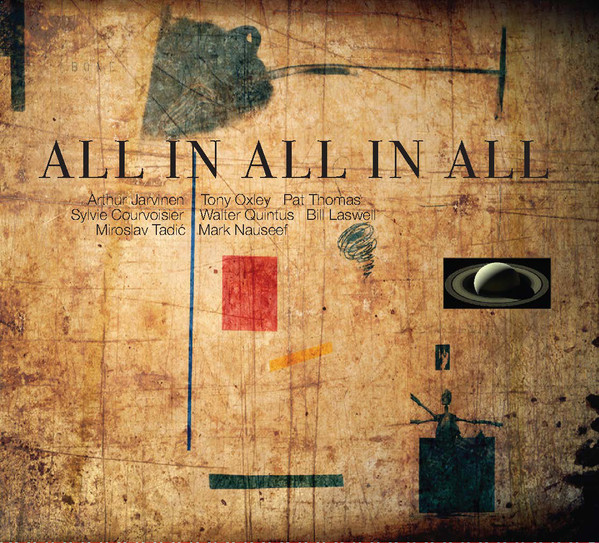
Though there are eleven tracks, the entirety of All in All in All ostensibly flows as a suite of diverse movements, moods, incongruities, flights of fancy, and abstract explorations. There exists an overt parallel drawn between the collage of the tri-fold artwork and the puzzlework construction of the music therein. Splashed on the digipak's panels are 'remixed'/reconstituted images from Nauseef's preceding releases, images from his work with early ensemble Dark (and subsequent quasi-regular partnerships with guitarist Miroslav Tadic, including the wonderful Snake Music), some extant CMP collaborations, particularly with David Torn, in addition to the shamanistic audiovisual merging found on his solo albums Wun-Wun and Sura. All in All in All could function as a career summation for Nauseef if the man were suddenly shot off into space, but (thankfully) he's still very much alive and active. It begs the question as to why Relative Pitch presents the album as it does, but no matter such considerations don't detract one iota from the music's perpetual motion and breathless imagination.
The lengthy track eight perhaps best reflects the canny goings-on that Nauseef corrals under his astute roof. Throughout its near fourteen-minute duration, we witness a cascading tumult of glimpsed and half-glimpsed sonic events; as there is an ample employment of electronics about, and various players double on their respective noisemakers, who's doing what remains mysterious and immutable, but in the end such specificities become moot. Nauseef and fellow percussionist Tony Oxley offer the initial percolations, followed by the probing piano strikes of Sylvie Courvoisier; these are soon joined (interrupted?) by peek-a-boo electronic nods and whispers, until Bill Laswell's recognizable bass lava thrusts up and under the bubbling seismic activity. What follows is a mighty battle to rescue nuance from chaos, as Tadic, Walter Quintus, and the rest of the collective out-spray their acoustic/electronic/found sounds with Pollack-like exuberance and a profound feel for eclectic, visionary color.
Hard to believe this music is eighteen years old, it could've been made then, today, or tomorrow. Like all great art, its execution is flawless, its urgency unquestionable, and its relevance timeless. Brighter than a thousand suns.
Darren Bergstein (courtesy of the Squids Ear website)